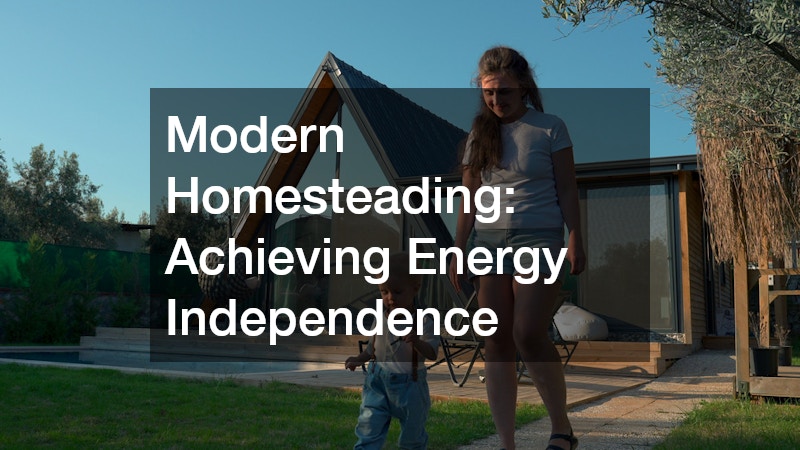
For a growing number of homeowners, self-reliance is no longer a romantic notion — it is a practical goal with a clear roadmap. Modern homesteading has evolved well beyond keeping a vegetable garden or stocking a pantry. Today, it means engineering your property from the ground up to generate its own power, manage its own waste, and operate with minimal dependence on outside systems. Whether you are building new or retrofitting an existing home, the strategies available today make true energy independence more achievable than at any point in history.
Establishing a High-Performance Building Envelope

Before you invest in solar panels or battery storage, you need to minimize the energy your home demands in the first place. A leaky, inefficient structure will eat through generated power regardless of how much capacity you build. The building envelope — walls, roof, floors, windows, and the connections between them — determines how much energy escapes your home and how much work your systems have to do to compensate. Tackling the envelope first creates a multiplier effect: every improvement you make here reduces the load on every other system downstream, which means smaller, less expensive generation and storage systems at every subsequent stage.
The framing choices you make during construction or major renovation directly affect long-term performance. Engineered lumber has become a preferred option among high-performance builders because it offers superior dimensional stability compared to traditional sawn timber. Unlike conventional wood, which can warp, shrink, or develop weak points over time, engineered lumber is manufactured to precise tolerances, reducing gaps that allow air and moisture infiltration. It also makes more efficient use of available wood fiber, meaning less raw material is harvested to achieve the same structural result.
Key advantages of engineered lumber in high-performance construction:
- Consistent dimensions reduce framing gaps that compromise insulation continuity
- Higher strength-to-weight ratios allow for longer spans with fewer load-bearing walls
- Lower susceptibility to moisture damage compared to dimensional lumber
- Compatible with advanced framing techniques that increase the insulated wall cavity space
Once the frame is in place, the most critical step is achieving a continuous air barrier. Gaps and cracks in a building envelope — even small ones — account for a significant portion of heating and cooling loss in the average home. A professional spray foam insulation company brings the tools and expertise to address areas that batt or blown-in insulation simply cannot reach effectively: rim joists, irregular framing cavities, penetrations around pipes and wiring, and the transitions between wall assemblies. There are two primary types to consider: open-cell foam, which is vapor-permeable and better suited for interior applications, and closed-cell foam, which delivers a higher R-value per inch and acts as a vapor barrier. A qualified installer will assess your climate zone and building assembly to recommend the right application for each area of the home.
Generating Renewable Power On-Site
With an efficient envelope established, the next phase is generating your own electricity. Solar photovoltaic systems have become the most accessible entry point for residential renewable energy, but getting the most out of an installation requires more than pointing panels south and hoping for the best. Professional solar services perform a detailed load analysis before designing a system — calculating your annual kilowatt-hour consumption, accounting for seasonal variation in sunlight, and identifying shading issues that could quietly reduce output by more than most homeowners expect. Getting this analysis right before committing to hardware is what separates a system that covers your needs from one that leaves you short on cloudy winter days.
A properly designed solar system for a homesteading property typically addresses:
- Total energy consumption, including heating, cooling, EV charging, and appliances
- Roof orientation and pitch relative to solar azimuth at your latitude
- Local weather patterns and average peak sun hours
- Future expansion capacity, if you plan to add storage or additional loads
Solar panels are a long-term investment, typically warrantied for 25 years or more. Installing them on a roof that needs replacement in five years creates an expensive and disruptive problem down the road. Before any solar hardware goes up, working with certified roofers to evaluate the existing roof is a non-negotiable step. They will assess structural load capacity, remaining membrane or shingle life, and the condition of flashing details that could allow water infiltration around mounting hardware. If a roof replacement is needed, doing it in tandem with solar installation is significantly more cost-effective than sequencing them separately. Many roofing contractors now specialize in solar-ready installations and can coordinate directly with your solar provider, streamlining the permitting and inspection process as well.
Storing Energy for True Grid Independence
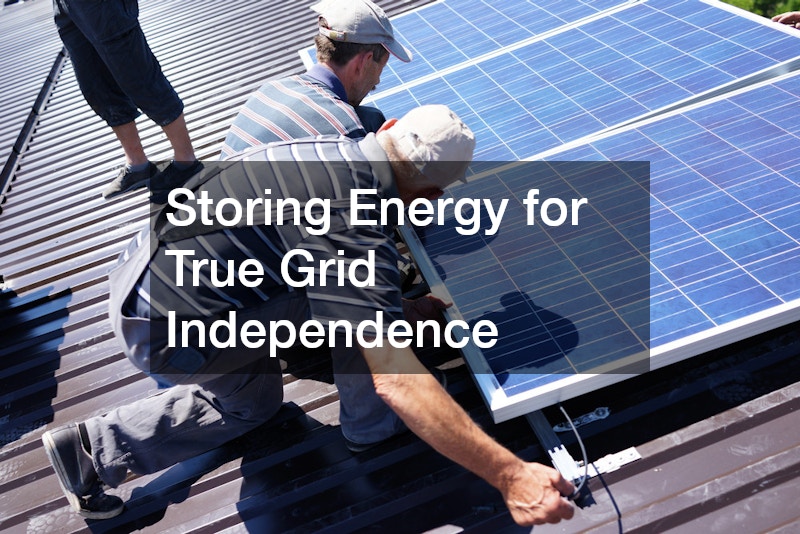
Generating solar power during daylight hours is only half of the energy independence picture. Without storage, any excess power you produce gets pushed back to the grid — and you are right back to depending on utility power after dark or during outages. Battery storage is what transforms a solar installation from a bill-reduction tool into a genuine resilience asset, and the gap between those two outcomes is significant for anyone serious about self-sufficiency.
A Tesla Powerwall installation gives homeowners the ability to capture surplus solar generation and deploy it on demand. The system integrates directly with your solar inverter and manages charge and discharge cycles automatically, prioritizing stored energy over grid draw during off-peak hours. During a grid outage, it can seamlessly transition to island mode, keeping essential circuits powered without interruption.
Benefits of residential battery storage in a homesteading context:
- Eliminates dependence on time-of-use rate spikes during evening peak hours
- Provides backup power for medical equipment, refrigeration, and communications
- Enables whole-home or partial-home backup depending on system configuration
- Works in conjunction with grid-tied solar without requiring a full off-grid setup
As battery capacity grows, some homesteaders progress to a fully off-grid configuration — disconnecting from the utility entirely. This requires careful load management and typically a larger battery bank paired with a generator for extended low-sun periods. For most properties, a grid-tied system with substantial storage strikes the better balance: you maintain grid access as a safety net while operating primarily on your own generated and stored power.
Controlling Passive Thermal Gain Through Windows
Windows are the weakest thermal link in most building envelopes. Even triple-pane glazing has a fraction of the insulating value of a well-insulated wall, and in a home that has been carefully air-sealed and insulated, glass becomes the dominant pathway for unwanted heat transfer in both directions. In homes with large glass areas — a common feature in modern homesteads designed to maximize natural light and connection to the landscape — managing solar heat gain becomes a significant energy lever that is easy to underestimate until you see its effect on cooling and heating bills.
For properties with extensive glazing, a commercial window treatment system offers a level of thermal performance that standard residential blinds cannot match. These systems use precision-engineered fabrics with measured solar heat gain coefficients, blocking a calculable percentage of solar radiation while still allowing diffuse daylight into the space. Unlike decorative blinds or curtains, which are selected primarily for aesthetics, these treatments are specified the way insulation is — based on R-value, openness factor, and visible light transmission data that tell you exactly what you are getting. When motorized and integrated with a smart home controller, they can respond to sun position and interior temperature automatically, requiring no daily intervention from the homeowner and ensuring optimal performance even when no one is paying attention.
Seasonal strategy with high-performance window treatments:
- Summer: Deploy treatments on south and west-facing glass during peak afternoon hours to reduce cooling load
- Winter: Retract treatments during daylight to allow passive solar heat gain, then close at night to reduce radiant heat loss
- Year-round: Use on skylights and clerestory windows where manual adjustment is impractical
The integration piece is worth emphasizing. A motorized system connected to your home automation platform can be programmed with location-based sun tracking, meaning the treatments respond to the actual solar angle at your specific coordinates rather than a generic timer. Paired with interior temperature sensors, the system can prioritize keeping rooms within a target range without touching the thermostat. For a homestead operating on stored solar energy, that kind of passive load management has a direct and measurable impact on how long your battery reserves last through the night or during a stretch of overcast weather. It is one of the few upgrades that reduces energy consumption without asking anyone to change their behavior.
Designing a Landscape That Reduces Energy Demand

The land surrounding your home is not decorative — it is functional infrastructure. Thoughtful landscape design can reduce wind exposure, manage stormwater, provide shade to reduce cooling loads, and support food production. Treating it as an extension of your building systems means every planting decision should serve multiple purposes, and decisions made carelessly here can undermine the efficiency gains you worked hard to build into the structure itself.
A landscaping company with expertise in permaculture and ecological design can help you move beyond conventional lawn-and-shrub arrangements to a property that works in productive cycles. Windbreaks planted on the north and northwest sides of a home in cold climates can meaningfully reduce heating demand by disrupting cold air infiltration. Rain gardens and swales manage stormwater on-site, reducing erosion and recharging groundwater rather than channeling runoff to a storm drain.
Productive landscape elements worth integrating:
- Native plantings that require no irrigation once established
- Fruit and nut trees positioned to provide summer shade on west-facing walls
- Raised bed kitchen gardens sited for maximum sun exposure
- Compost systems that process kitchen and yard waste into soil amendment
A homestead is a place to live, not just a production system. Making outdoor areas genuinely comfortable extends the living space of the home and reduces the temptation to rely on climate-controlled interiors for every activity. A mosquito control service that uses pollinator-safe, targeted treatments — rather than broad-spectrum pesticide applications — keeps outdoor kitchens, dining areas, and work zones usable through warm months without undermining the ecosystem your landscape is designed to support.
Implementing Closed-Loop Waste and Material Management
One of the distinguishing philosophies of modern homesteading is the refusal to treat any material as inherently disposable. Building projects, landscaping work, and home system upgrades all generate material streams that, managed intentionally, can be redirected into productive use on-site or returned to responsible recycling channels. This mindset takes some adjustment if you are coming from conventional construction habits, but it has both environmental and financial payoffs that compound over time.
For driveways, access paths, and utility areas around a homestead, crushed asphalt recycling offers a practical and environmentally sound alternative to new asphalt or concrete. Reclaimed asphalt aggregate — typically sourced from road milling projects — is compacted in place to create a durable, semi-permeable surface. It costs significantly less than virgin paving materials, reduces the industrial energy required to manufacture new aggregate, and allows water to percolate through rather than sheet off into drainage systems. In a property designed to manage its own water, preventing runoff is fundamental. Every square foot of impermeable surface redirects precipitation away from groundwater recharge and into municipal drainage — the opposite of what a self-sufficient property should be doing.
Electrical system upgrades are a recurring reality on any homestead that is progressively adding solar, battery storage, EV charging, and automation infrastructure. Each upgrade generates copper and aluminum wire offcuts that represent significant material value. Wire recycling through a certified scrap metal facility ensures these materials re-enter the manufacturing supply chain rather than accumulating in a landfill. Beyond the environmental benefit, copper in particular carries meaningful scrap value. On a large homestead project, accumulating and selling wire scrap can partially offset installation costs — a small but real contribution to the overall project economics.
Building Toward a Resilient Future
Modern homesteading is not a single project with a completion date. It is an ongoing commitment to improving the efficiency, self-sufficiency, and ecological integrity of your property over time. Each upgrade compounds the value of what came before: better insulation reduces the size of the solar array you need; a right-sized array reduces the battery capacity required; reduced battery demand lowers total system cost.
The financial case for this approach has strengthened considerably as material costs for solar, battery storage, and high-performance insulation have declined. Federal and state incentive programs continue to make initial investments more accessible. But the deeper return is harder to quantify — the sense of security that comes from knowing exactly where your energy comes from, how your home stays warm in winter and cool in summer, and what happens to the materials that cycle through your property.
About the Author